If you had told me four summers ago that I would spend a ridiculous amount of money to camp for four days with around 8,000 vegans, I would’ve called you crazy.
But that is exactly what I did at Vegan Camp Out 2026 and it was genuinely wonderful.
Dusty? Yes. Expensive? Also yes. Hot enough to cook a vegan sausage on the hood of our car? Definitely. But wonderful all the same.
So here is my honest Vegan Camp Out 2026 review: the food, talks, people, 35°C heat, and the strange adjustment back to everyday life.
The person who would never have gone to Vegan Camp Out a few years back
A few years ago, I was not nearly as vegan-friendly as I am now. I was vegetarian, as I had been for most of my life, and I thought vegans were a bit extreme. I mean, come on. Who in their right mind could give up cheese?
Photo of cheese that I took because I thought it's not so bad...
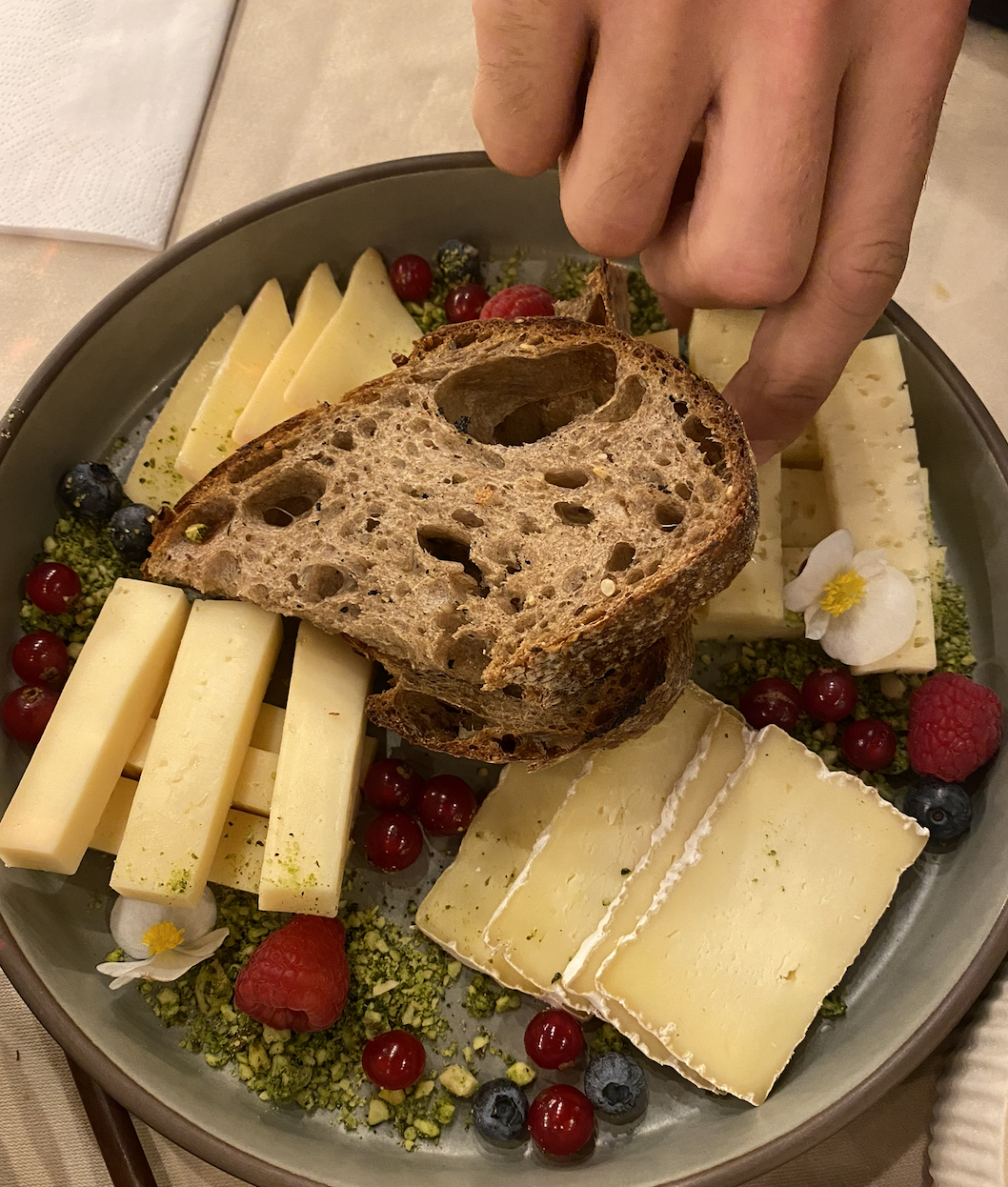
I believed the familiar line that cows liked being milked. What I had never confronted was why cows produce milk in the first place: they must first give birth, and in the dairy industry their calves are taken away. Learning that changed the way I saw cheese - and veganism - completely.
Is being vegan really that hard? No, especially when you keep the animals in mind. But it can be extremely inconvenient, and it sometimes requires a deeper knowledge of where animal products may be hidden in plain sight. I had no idea what gelatin was, for example. Labelling schemes such as V-Label are making things easier, but checking is still part of everyday life.
The hidden work of eating out
I generally need to be the one who chooses where we eat. And in most cases, I would rather stay home. It is much easier to know what I am actually consuming.
Going out for dinner with friends means I cannot order carelessly, especially in countries where veganism is new. For example, let us say I order a bean soup in Bulgaria. Chances are the broth is made from bones and there are going to be chunks of lard (pig fat) mixed in. So even if a restaurant says something is vegan, its idea of vegan may be very different from what vegan actually means.
And I can’t blame them. For a long time, I assumed simple things like candy, chips, salad, fries, and wine would be vegan. Often, they are not:
Candy can contain gelatin.
Chips can contain milk powder, because apparently potatoes were not doing enough on their own.
Salad dressing can contain dairy—and in Bulgaria, putting cheese on everything is practically a national sport.
Fries may be cooked in lard or beef tallow.
Wine can be clarified using eggs or other animal-derived substances.
Cosmetics can contain animal-derived ingredients, while vegan and cruelty-free are two separate labels.
Seriously, the list never seems to end.
Even my boyfriend, who is not vegan but has heard me preach about this for years, still gets confused sometimes. Something can look completely innocent and plant-based until you learn what has been added to it or how it was produced.
I used to laugh at labels declaring shampoo vegan. I was not going to eat it, after all. What I missed was that animal-derived ingredients may be added to these, and that it may also be tested on animals.
I still remember seeing the word vegan on a bottle of wine a few years ago and thinking, What the fuck do vegans need vegan wine for? How ridiculous.
Oh, how naïve I was.
Or maybe programmed is the better word. Most of us are taught not to question how everyday products are made. Why would I imagine that wine could involve animal products? It is fermented grapes, right?
Enter the vegan bubble
Vegan Camp Out is a four-night vegan festival in England, welcoming both vegans and the vegan-curious. Most people sleep in tents, and the programme combines vegan food, music, comedy, talks, activism, yoga, and enough things happening at once to make choosing an activity a chore.
More than anything, it felt like stepping into a temporary vegan world. Honestly, it was so incredibly pleasant. It would be a fucking fantastic world to live in, so please: can we make that happen within our lifetimes?
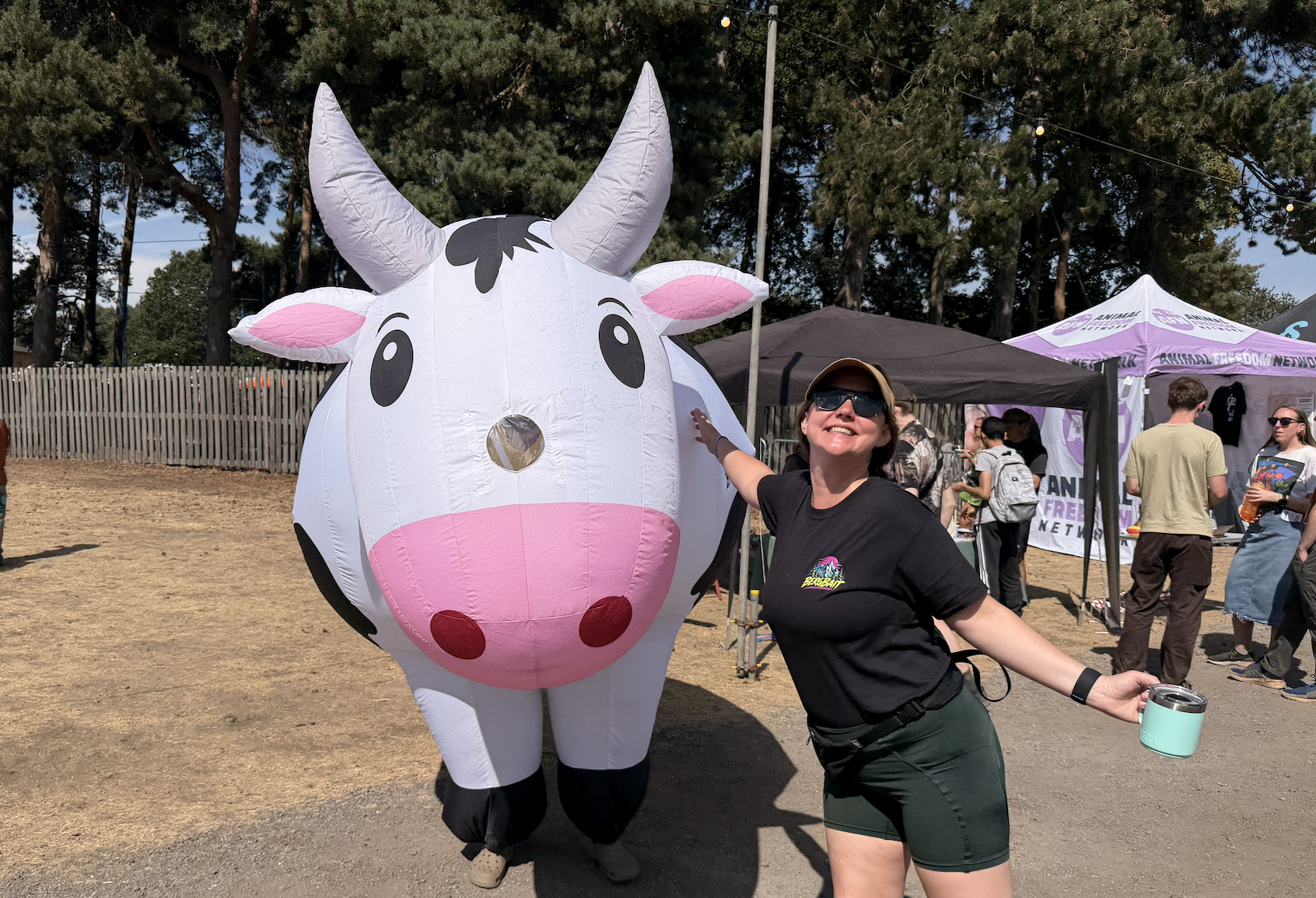
We arrived late on Thursday night after getting tickets that allowed us in a day early. This gave us a better choice of camping spots, and we found a lovely one beside the forest line.
The full programme did not really get going until Saturday, so Thursday and Friday were mostly for pitching the tent, trying food, and listening to music. The festival’s speakers and performers were vegan too, which made the whole event feel unusually consistent. Veganism was not a side option, a special request, or a sad little meal hiding at the bottom of the menu.
Veganism was the default. That difference sounds small. It was anything but.
The setting was less idyllic than the feeling. After an exceptionally dry summer, the landscape around Walesby Forest had turned brown and dusty, and temperatures reached 35°C during the day. The heat was brutal. The dust got everywhere. Practical advice if you attend in similar conditions: bring something to rinse out your nose.
What socializing with thousands of vegans was like
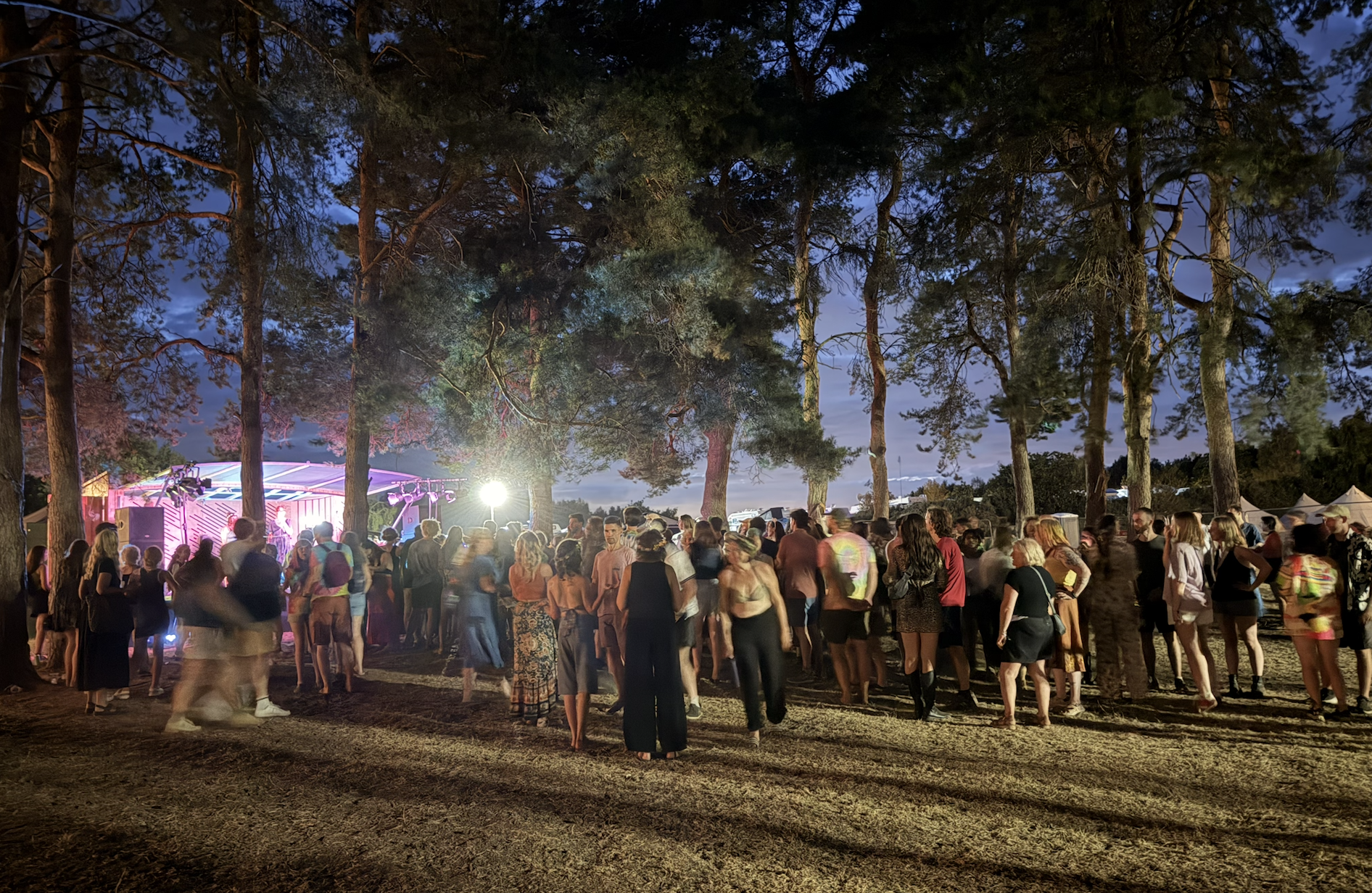
I have never been to such a respectful festival. People talked, but they did not blast music across the campsite. If someone needed something, another person usually had it and was willing to share. At the end of the weekend, the grounds were spotless. I did not see abandoned tents or piles of rubbish anywhere.
Everyone we spoke to was friendly, although with a festival this large, most conversations were fleeting: a chat in a queue, a joke near a stage, a quick moment of recognition with someone you would probably never see again.
The person we connected with most was our tent neighbour. It was his fourth Vegan Camp Out, and he was there with people he had met during previous years. We shared late-night conversations, a few dances, and the temporary intimacy that seems to happen when everyone is sleeping outdoors and has collectively accepted that being covered in dust is now a personality trait.
I probably would have socialized more if I had gone alone. Travelling with someone you love can put you in a comfortable little bubble: you already have your person, so there is less pressure to take social risks. We also do not live in the UK, so even if we met our new best friends, there was a good chance we would only see them again at the next Vegan Camp Out.
Still, the crowd felt unusually safe and welcoming. There were no painful silences when you spoke to someone new, and the festival attracted people of all ages, from babies to people who had been vegan longer than I have been alive. Looking at you, Moby!
It was also one of the most visibly disability-aware festivals I have attended. There was an accessible area, signs reminding people that not every disability is visible, and a general sense that disabled people were expected to be there rather than treated as an inconvenient surprise.
The freedom and mild frustration of Vegan Camp Out food
Note: all of the pictures here were taken from Instagram from some of the creators that influenced me going vegan. I was more focused on eating than capturing the food. Please follow them: @itsjamielogan @dr.matthewnagra @dannyishay @humane_vision
Eating out as a vegan usually involves endless amounts of friction unless you are in a completely vegan restaurant. I have lost count of the times I have told someone I was vegan, heard “Yes, no problem,” and then found chicken, milk, gelatin, or lard in the food. If I had a penny for every misunderstanding, I would be rich AF.
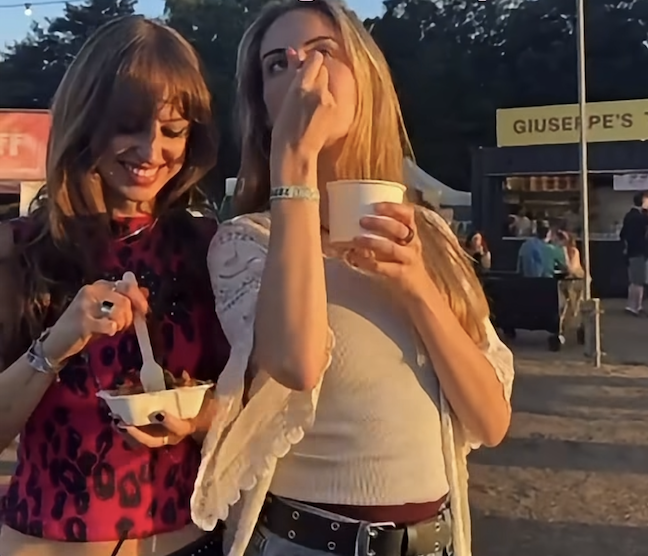
At Vegan Camp Out, every food stall was vegan. I could order anything without an extensive list of questions. What I found funny though was, I still heard people asking, “Is this really vegan?” Apparently, the habit of checking is hard to switch off.
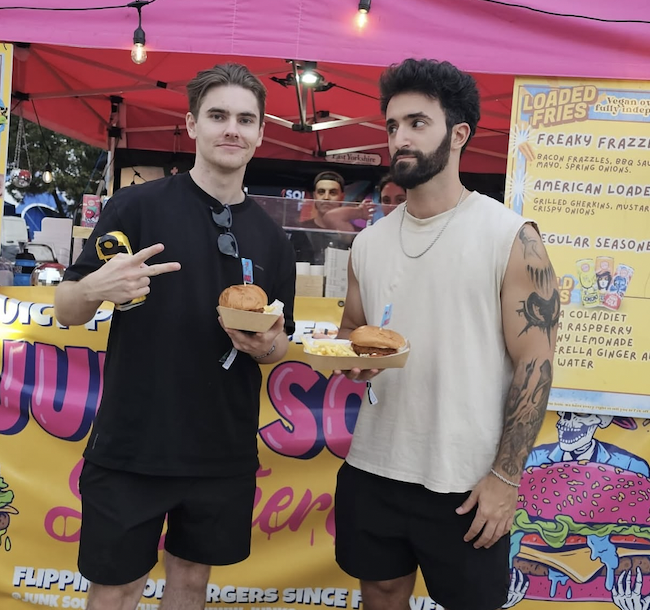
I did not try every stall, but the food was generally good. Some of it was excellent. Some of it was a bit of a let down.
Meatless Farm was one of the main sponsors, and you could get 20 nuggets for £10. They were genuinely some of the best vegan nuggets I have tried. I also had a crispy vegan chicken burger with maple syrup, which hit that perfect sweet-salty combination.
There were approximately ten stalls selling mac and cheese. I love mac and cheese, but even I began to wonder whether we had entered the mac and cheese multiverse. I tried three versions, and my favourite was from Mac Majesty, topped with crispy onions and vegan meat pieces.
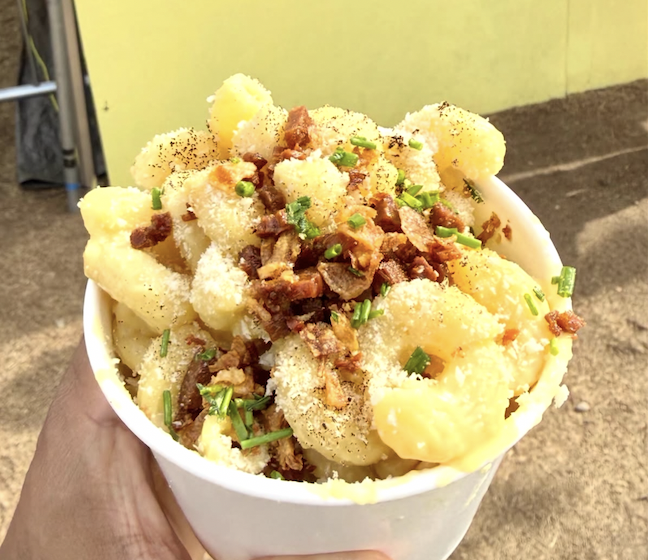
The low point was a serving of tofish and chips: mostly dough and chips with a tiny piece of tofu hidden somewhere inside, all for £15. It was the saddest thing I ate all weekend. I have seen more generous tofu portions in a miso soup.
That bothered me because the two complaints I hear most often about vegan food are that it tastes bad and that it is too expensive. A vegan festival should be the place where both arguments are decisively disproven. Instead, a few vendors seemed determined to provide supporting evidence.
With 45 food stalls feeding thousands of people, everywhere had a queue. One popular vendor even raised its prices during the festival. When I asked why, I was told, essentially, “It’s the economy, what do you expect?”.
Capitalism, but make it vegan.
Still, there was something wonderful about choosing food based on what looked good rather than what happened to be safe. Even when the food was imperfect, that freedom was new to me.
What I learned at Vegan Camp Out 2026
The advertised programme included comedy, music, and talks from people whose work had already helped me understand veganism. Moby, Henning Wehn, Earthling Ed, Zack Polanski, Raffaela Raab, Menkay, Jamie Logan, Dr. Matthew Nagra, and Diane Morgan were among the names that drew me to the festival, although not everyone was able to appear in person. Looking at you Dianne Morgan (you better figure out how to show up next year).
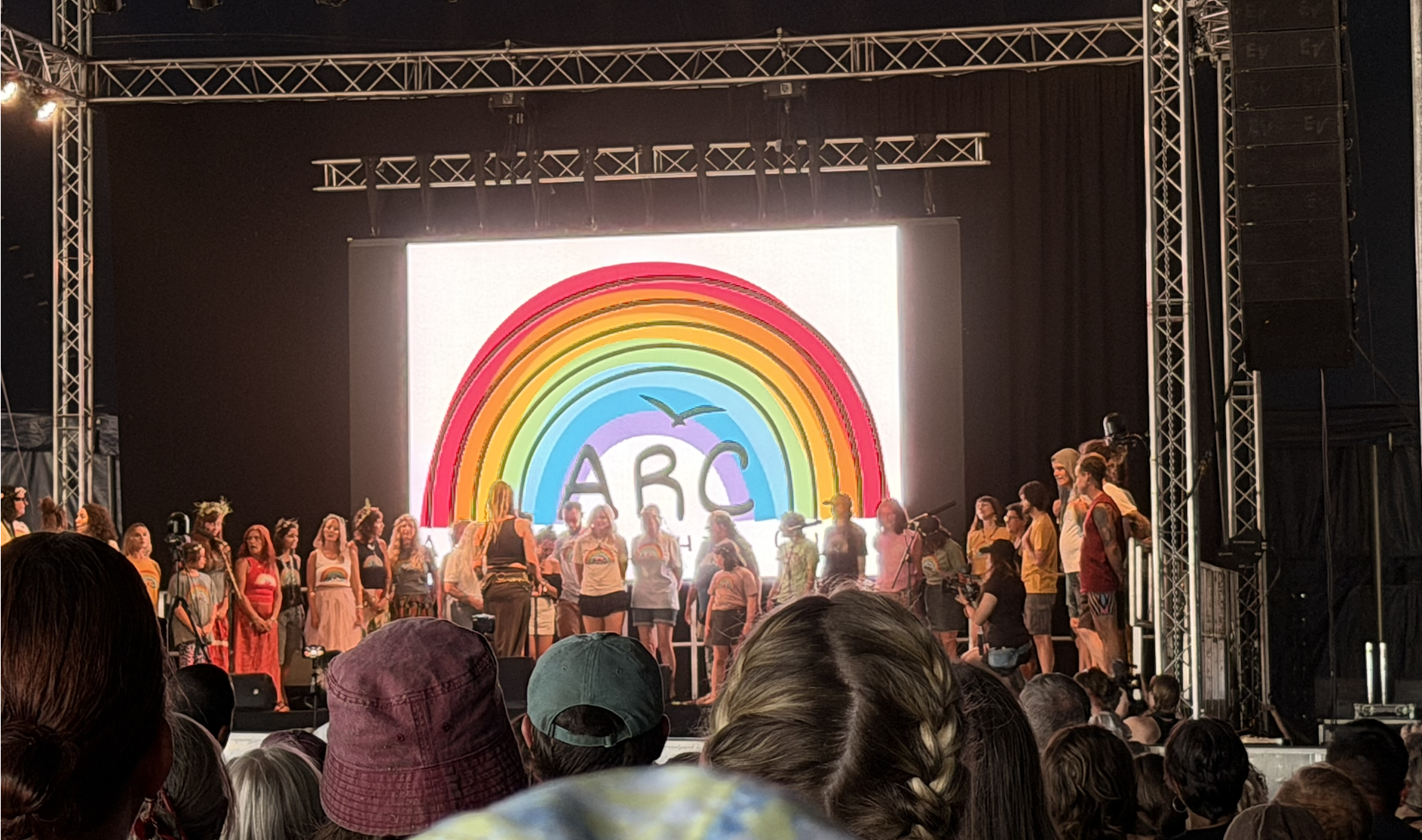
Moby probably needs no introduction if you are North American or have spent much time in vegan spaces. He is the musician behind songs including “Porcelain,” “Natural Blues,” and “Why Does My Heart Feel So Bad?” What I had not realised was quite how long he had been active in the vegan movement: he became vegan in 1987 (a year before I was born), when finding a decent plant-based burger required considerably more imagination than it does today.
But a list of famous names is not the interesting part. The interesting part is what stayed with me.
1. Anger is understandable, but it is rarely persuasive
It is hard to live in a world that does not align with your values. Once you stop seeing a chicken wing as just “food,” you see the wing that once belonged to an animal. Your first internal response may not be calm, generous, or suitable for friendly dinner conversation.
But yelling at someone or judging them is unlikely to change their mind. Most vegans were once on the other side of that conversation too. I certainly was. People usually need time, information, and a series of small moments before something finally clicks.
You can be furious about the system without treating every individual as your personal enemy. It is also far less exhausting to think, “This person is simply a future vegan.”
2. Vegan food does not need to pass a purity test
The talks also made me reconsider how suspicious we can be of plant-based alternatives. A vegan steak does not need to be a raw carrot to count as food. Alternatives can be practical, enjoyable, and a useful bridge for people who want familiar meals without using animals.
That does not mean I need to eat three vegan steaks every day. It just means “processed” is not a complete nutritional argument, and swapping an animal product for a plant-based one does not automatically make a meal worse.
3. Veganism is bigger than a diet
Veganism is sometimes grouped with other supposedly “extreme” ways of eating: carnivore diets, juice cleanses, and whatever else the internet has decided will transform your life by Tuesday. But veganism is not simply a menu plan. It is an ethical framework that affects food, clothing, cosmetics, entertainment, and the way we think about other animals.
VCO showed very clearly that it is not a fad. Diet trends come and go. Once you genuinely make the connection between an animal and the product in front of you, it is difficult to unsee it.
The biggest lesson, however, may have had less to do with the stage and more to do with the weekend itself. For four days, I did not have to explain why I did not eat animals. I did not have to decode a menu, inspect every packet, or worry that someone had misunderstood what vegan meant.
The mental work I usually carry simply disappeared.
That made me realise that veganism is not inherently difficult. Much of the difficulty comes from moving through a world built around the assumption that animals are ingredients.
Why this is exactly what Bergbait trips are about
I do not know whether the weekend radically changed my beliefs. A lot of the lessons reinforced things I already knew. What changed was how clearly I understood that I need more experiences like this in my life.
That is also what Bergbait trips are all about.
Travel should be more than changing your location, photographing a landmark, and returning home with 400 nearly identical pictures. The best trips let you step into a different version of life.
They put you among people who share your curiosity, give you room to question your assumptions, and send you home seeing your everyday world a little differently.
Sometimes that means a beautiful landscape. Sometimes it means a conversation with the stranger in the next tent. Sometimes it means eating your body weight in vegan mac and cheese and calling it cultural research.
Bergbait trips are built for those experiences: the ones that connect people, create stories, and stay with you after the tent has been packed away.
If that sounds like your kind of travel, explore upcoming Bergbait trips and see where we are going next.
Going back to real life after Vegan Camp Out
Then the festival ended.
We packed up our tent, left the clean campsite behind, and returned to a world where vegan food was once again the exception rather than the default.
The bubble burst almost immediately. There were signs for fish and chips, McDonald’s advertisements, and the familiar pressure to start checking every label again. For four days, my partner and I had lived in harmony with thousands of other vegans. Suddenly, I felt exhausted.
No longer could I simply exist in my little vegan world. I had to explain, check, question, and negotiate again.
Of course, none of the inconvenience I experience compares with what animals endure every day. But returning home made the background effort of vegan life newly visible. All the tiny negotiations came back: scanning menus, reading labels, asking questions, and wondering whether “yes, it is vegan” really meant yes.
None of this was new. After four days without it, though, I noticed its weight.
Vegan Camp Out did not show me a perfect vegan world. There were queues, dust, high prices and disappointing food. But it did show me what changes when veganism is treated as normal rather than extreme.
Four years ago, I thought vegans were making life unnecessarily difficult. Now I think the opposite may be true: the world makes a compassionate choice unnecessarily difficult, then blames the people trying to make it better.
Would I go back to Vegan Camp Out? Absolutely.
Next time, though, I will bring my own coffee. And when I am back in that clean field beside the forest, surrounded by tents and people who understand without explanation, I will be trying to reach all the vegans who might want to come on the next trip with us.
Want to hear more?
Subscribe for more stories on the mountains and for upcoming trips!